

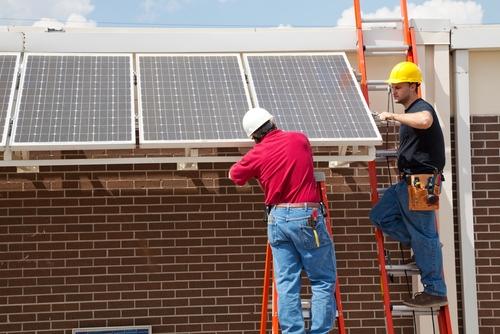
Recently, Senator Mark Udall of Colorado introduced a bill that would make it easier for the owners of solar photovoltaic (PV) panels connected to community solar gardens to received federal renewable energy tax credits. While shared solar gardens are a great option for anyone who is unable to install a rooftop system, such as renters or condo owners subject to homeownerse association (HOA) rules, something for California residents to remember is that it is actually illegal for an HOA to prohibit its members from installing solar power.
The right to construct solar energy and other renewable power sources on your property is guaranteed by the Solar Rights Act of 1978, which barred HOAs from enforcing rules that would limit the expansion of such technologies. It is important to keep this in mind because, although a community solar garden is certainly better than no solar energy, homeowners are much better off if they have a rooftop system installed on their home. Doing so allows the resident to take full advantage of tax credits and utility rebates without having to pay a fee or share those benefits with the operator of a solar garden.
That the state protects the right of homeowners to make modifications to their property is a good thing, because although there are some legitimate reasons to enforce HOA rules, such as aesthetic consistency and safety concern, solar panels offer only benefits to the neighborhood. A residential PV system provides an unlimited, clean source of electricity without producing emissions or pollutants that can be detrimental to public health and air quality.
If you’re interested in finding out more about the benefits of North California solar power for your community, contact West Coast Solar today.
Schedule A Free Consultation
The entire West Coast Solar team is excited to help you optimize your energy potential. Connect with us today to schedule your complimentary consultation to learn more about a home solar panel system or a commercial solar panel system. We look forward to hearing from you!
Recent Posts
PG&E’s New Flat Fee Just Hit Your Bill: Does Solar Still Make Sense?
If you opened your latest PG&E statement and noticed a sudden, unavoidable fee, you aren’t alone. In March 2026, PG&E officially rolled out its “Base Services Charge”—an automatic fee of…
Read MoreUpgrading Your HVAC This Year? Why California’s 2026 Building Codes Make Solar + Heat Pumps a No-Brainer
If your old gas furnace is on its last legs, you are about to encounter the new reality of California real estate. On January 1, 2026, the updated California Energy…
Read MoreSolar Panels vs. Bidirectional EV Charging: Do You Still Need a Tesla Powerwall in 2026?
The California energy landscape is evolving fast. With automakers expanding bidirectional charging across their 2026 vehicle lineups and models like the Ford F-150 Lightning and Tesla Cybertruck already on the…
Read More